Jul 30 08
by cara
at 9:28 AM

Filbert Gateau with Praline Buttercream

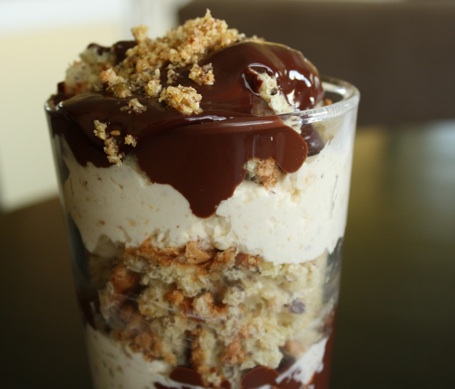
This month’s Daring Baker’s challenge, selected by Chris of Mele Cotte was a layer cake from Great Cakes by Carol Walter.  A Filbert Gateau with Praline Buttercream, to be exact.  It sounded delicious: praline buttercream, chocolate ganache, and filberts (aka hazelnuts…I don’t actually know anyone who calls them filberts, do you?).  This recipe was super time-consuming, but I wasn’t intimidated.  Perhaps I should have been!  For me, it was the most challenging Daring Baker’s challenge yet.  I had a very trying time removing the skins from all of the hazelnuts (despite using many of the tips and tricks written about by my fellow Daring Bakers).  My cake fell apart as I was taking it out of the pan, rendering it un-layerable.  The taste of the cake is alright, but probably not my favorite texture.  At this point, I decided I would make a trifle-like dessert, layering all of the components together instead of the beautiful layer cake I first envisioned.  Next it was on to the praline buttercream….I burnt my first batch of sugar while making pralines, and had a doozy of a time getting the burnt sugar off of my non-stick skillet.  I think my little food processor might be on its last legs after grinding those pralines into paste.  Luckily, after that, my buttercream came together nicely, though I did have a moment of panic when it started to look like cottage cheese.  My chocolate ganache also came together perfectly, and tastes fabulous!  I won’t be making this cake again, but I’m so glad I completed the challenge for this month.  I can’t wait to see what’s in store for us next time!  To see what this cake is supposed to look like and some absolutely gorgeous cakes, be sure to check out Chris’s post as well as the Daring Bakers blogroll!  Thanks again to this month’s hostess for selecting such an excellent challenge.  Even though mine fell apart, I enjoyed the experience!
Filbert Gateau with Praline Buttercream

From Great Cakes by Carol Walter

1 Filbert Genoise
1 recipe sugar syrup, flavored with dark rum
1 recipe Praline Buttercream
½ cup heavy cream, whipped to soft peaks
1 recipe Apricot Glaze
1 recipe Ganache Glaze, prepared just before using
3 tablespoons filberts, toasted and coarsely chopped

Filbert Genoise
Because of the amount of nuts in the recipe, this preparation is different from a classic genoise.

1 ½ cups hazelnuts, toasted/skinned
2/3 cup cake flour, unsifted
2 Tbsp. cornstarch
7 large egg yolks
1 cup sugar, divided ¼ & ¾ cups
1 tsp. vanilla extract
½ tsp. grated lemon rind
5 lg. egg whites
¼ cup warm, clarified butter – 100 – 110 degrees

Position rack in the lower 3rd of the oven and preheat to 350 degrees. Grease and flour a 10” X 2” inch round cake pan.

Using a food processor, process nuts, cake flour, and cornstarch for about 30 seconds. Then, pulse the mixture about 10 times to get a fine, powdery mixture. You’ll know the nuts are ready when they begin to gather together around the sides of the bowl. While you want to make sure there aren’t any large pieces, don’t over-process. Set aside.

Put the yolks in the bowl of an electric mixer, with the whisk attachment, and beat until thick and light in color, about 3-4 minutes on med-high speed. Slowly, add ¾ cup of sugar. It is best to do so by adding a tablespoon at a time, taking about 3 minutes for this step. When finished, the mixture should be ribbony. Blend in the vanilla and grated lemon rind. Remove and set aside.

Place egg whites in a large, clean bowl of the electric mixer with the whisk attachment and beat on medium speed, until soft peaks. Increase to med-high speed and slowly add the remaining ¼ cup of sugar, over 15-20 seconds or so. Continue to beat for another ½ minute.
Add the yolk mixture to the whites and whisk for 1 minute.

Pour the warm butter in a liquid measure cup (or a spouted container). * It must be a deep bottom bowl and work must be fast.* Put the nut meal in a mesh strainer (or use your hand – working quickly) and sprinkle it in about 2 tablespoons at a time – folding it carefully for about 40 folds. Be sure to exclude any large chunks/pieces of nuts. Again, work quickly and carefully as to not deflate the mixture. When all but about 2 Tbsp. of nut meal remain, quickly and steadily pour the warm butter over the batter. Then, with the remaining nut meal, fold the batter to incorporate, about 13 or so folds.

With a rubber spatula, transfer the batter into the prepared pan, smoothing the surface with the spatula or back of a spoon. **If collected butter remains at the bottom of the bowl, do not add it to the batter! It will impede the cake rising while baking.

Tap the pan on the counter to remove air bubbles and bake in the preheated oven for 30-35 minutes. You’ll know the cake is done when it is springy to the touch and it separates itself from the side of the pan. Remove from oven and allow to stand for 5 minutes. Invert onto a cake rack sprayed with nonstick coating, removing the pan. Cool the cake completely.

*If not using the cake right away, wrap thoroughly in plastic wrap, then in a plastic bag, then in the refrigerator for up to 3 days. If freezing, wrap in foil, then the bag and use within 2-3 months.

Sugar Syrup
Makes 1 cup, good for one 10-inch cake – split into 3 layers

1 cup water
¼ cup sugar
2 Tbsp. dark rum or orange flavored liqueur

In a small, yet heavy saucepan, bring the water and sugar to a boil and simmer for 5 minutes. Remove from heat, add the liqueur. Cool slightly before using on the cake. *Can be made in advance.

Praline Buttercream
1 recipe Swiss Buttercream
1/3 cup praline paste
1 ½ – 2 Tbsp. Jamaican rum (optional)

Blend ½ cup buttercream into the paste, then add to the remaining buttercream. Whip briefly on med-low speed to combine. Blend in rum.

Swiss Buttercream
4 lg. egg whites
¾ cup sugar
1 ½ cups (3 sticks) unsalted butter, slightly firm
1 ½ -2 Tbsp. Grand Marnier or liqueur of your choice
1 tsp. vanilla

Place the egg whites in a lg/ bowl of a elevtric mixer and beat with the whisk attachment until the whites are foamy and they begin to thicken (just before the soft peak stage). Set the bowl over a saucepan filled with about 2 inches of simmering water, making sure the bowl is not touching the water. Then, whisk in the sugar by adding 1-2 tablespoon of sugar at a time over a minutes time. Continue beating 2-3 minutes or until the whites are warm (about 120 degrees) and the sugar is dissolved. The mixture should look thick and like whipped marshmallows.
Remove from pan and with either the paddle or whisk attachment, beat the egg whites and sugar on med-high until its a thick, cool meringue – about 5-7 minutes. *Do not overbeat*. Set aside.

Place the butter in a separate clean mixing bowl and, using the paddle attachment, cream the butter at medium speed for 40-60 seconds, or until smooth and creamy. *Do not overbeat or the butter will become toooooo soft.*

On med-low speed, blend the meringue into the butter, about 1-2 Tbsp. at a time, over 1 minute. Add the liqueur and vanilla and mix for 30-45 seconds longer, until thick and creamy.

Refrigerate 10-15 minutes before using.

Wait! My buttercream won’t come together! Reheat the buttercream briefly over simmering water for about 5 seconds, stirring with a wooden spoon. Be careful and do not overbeat. The mixture will look broken with some liquid at the bottom of the bowl. Return the bowl to the mixer and whip on medium speed just until the cream comes back together.

Wait! My buttercream is too soft! Chill the buttercream in the refrigerator for about 10 minutes and rewhip. If that doesn’t work, cream an additional 2-4 Tbsp. of butter in a small bowl– making sure the butter is not as soft as the original amount, so make sure is cool and smooth. On low speed, quickly add the creamed butter to the buttercream, 1 Tbsp. at a time.

Refrigerate in an airtight container for up to 5 days, or can be frozen for up to 6 months. If freezing, store in 2 16-oz. plastic containers and thaw in the refrigerator overnight or at room temperature for several hours.

Praline Paste
1 cup (4 ½ oz.) Hazelnuts, toasted/skinless
2/3 cup Sugar
Line a jelly roll pan with parchment and lightly butter.

Put the sugar in a heavy 10-inch skillet. Heat on low flame for about 10-20 min until the sugar melts around the edges. Do not stir the sugar. Swirl the pan if necessary to prevent the melted sugar from burning. Brush the sides of the pan with water to remove sugar crystals. If the sugar in the center does not melt, stir briefly. When the sugar is completely melted and caramel in color, remove from heat. Stir in the nuts with a wooden spoon and separate the clusters. Return to low heat and stir to coat the nuts on all sides. Cook until the mixture starts to bubble. **Remember – extremely hot mixture.** Then onto the parchment lined sheet and spread as evenly as possible. As it cools, it will harden into brittle. Break the candied nuts into pieces and place them in the food processor. Pulse into a medium-fine crunch or process until the brittle turns into a powder. To make paste, process for several minutes. Store in an airtight container and store in a cook dry place. Do not refrigerate.

Apricot Glaze
Good for one 10-inch cake
2/3 cup thick apricot preserves
1 Tbsp. water

In a small, yet heavy saucepan, bring the water and preserves to a slow boil and simmer for 2-3 minutes. If the mixture begins to stick to the bottom of the saucepan, add water as needed.

Remove from heat and, using a strainer, press the mixture through the mesh and discard any remnants. With a pastry brush, apply the glaze onto the cake while the cake is still warm. If the glaze is too thick, thin to a preferred consistency with drops of water.

Ganache Glaze
Makes about 1 cup, enough to cover the top and sides of a 9 or 10 inch layer or tube cake

**Ganache can take on many forms. While warm – great fudge sauce. While cool or lukewarm – semisweet glaze. Slightly chilled – can be whipped into a filling/frosting. Cold & solid – the base of candied chocolate truffles.

6 oz. (good) semisweet or bittersweet chocolate, like Lindt
6 oz. (¾ cup heavy cream
1 tbsp. light corn syrup
1 Tbsp. Grand Marnier, Cointreay, or dark Jamaican rum (optional)
¾ tsp. vanilla
½ – 1 tsp. hot water, if needed

Blend vanilla and liqueur/rum together and set aside.

Break the chocolate into 1-inch pieces and place in the basket of a food processor and pulse until finely chopped. Transfer into a medium sized bowl and set aside.

Heat the cream and corn syrup in a saucepan, on low, until it reached a gentle boil. Once to the gently boil, immediately and carefully pour over the chocolate. Leave it alone for one minute, then slowly stir and mix the chocolate and cream together until the chocolate is melted and incorporated into the cream. Carefully blend in vanilla mixture. If the surface seems oily, add ½ – 1 tsp hot water. The glaze will thicken, but should still be pourable. If it doesn’t thicken, refrigerate for about 5 minutes, but make sure it doesn’t get too cold!

Assembling Cake

Cut a cardboard disk slightly smaller than the cake. Divide the cake into 3 layers and place the first layer top-side down on the disk. Using a pastry brush, moisten the layer with 3-4 Tbsp. of warm sugar syrup. Measure out 1 cup of praline buttercream and set aside.

Spread the bottom layer with a ¼-inch thickness of the remaining buttercream. Cover with ½ of the whipped cream, leaving ¼-inch border around the edge of the cake. Place the middle layer over the first, brush with sugar syrup, spreading with buttercream. Cover with the remaining whipped cream.

Moisten the cut side of the third layer with additional sugar syrup and place cut side down on the cake. Gently, press the sides of the cake to align the layers. Refrigerate to chill for at least 30 minutes.

Lift the cake by sliding your palm under the cardboard. Holding a serrated or very sharp night with an 8-ich blade held parallel to the sides of the cake, trim the sides so that they are perfectly straight. Cut a slight bevel at the top to help the glaze drip over the edge. Brush the top and sides of the cake with warm apricot glaze, sealing the cut areas completely. Chill while you prepare the ganache.

Place a rack over a large shallow pan to catch the ganache drippings. Remove the gateau from the refrigerator and put it the rack. With a metal spatula in hand, and holding the saucepan about 10 inches above the cake, pour the ganache onto the cake’s center. Move the spatula over the top of the ganache about 4 times to get a smooth and mirror-like appearance. The ganache should cover the top and run down the sides of the cake. When the ganache has been poured and is coating the cake, lift one side of the rack and bang it once on the counter to help spread the ganache evenly and break any air bubbles. (Work fast before setting starts.) Patch any bare spots on the sides with a smaller spatula, but do not touch the top after the “bang”. Let the cake stand at least 15 minutes to set after glazing.

To garnish the cake, fit a 12 – 14-inch pastry bag with a #114 large leaf tip. Fill the bag with the reserved praline cream. Stating ½ inch from the outer edge of the cake, position the pastry tube at a 90 degree angle with the top almost touching the top of the cake. Apply pressure to the pastry bag, moving it slightly toward the center of the cake. As the buttercream flows on the cake, reverse the movement backward toward the edge of the cake and finish by pulling the bag again to the center. Stop applying pressure and press the bag downward, then quickly pull the tip up to break the flow of frosting. Repeat, making 12 leaves evenly spaced around the surface of the cake.

Make a second row of leaves on the top of the first row, moving the pastry bag about ¾ inch closer to the center. The leaves should overlap. Make a 3rd row, moving closer and closer to the center. Add a 4th row if you have the room. But, leave a 2-inch space in the center for a chopped filbert garnish. Refrigerate uncovered for 3-4 hours to allow the cake to set. Remove the cake from the refrigerator at least 3 hours before serving.

Leftover cake can be covered with foil and kept in the refrigerator for up to 5 days.
Jul 15 08
by cara
at 8:12 PM

Banana Crumb Muffins

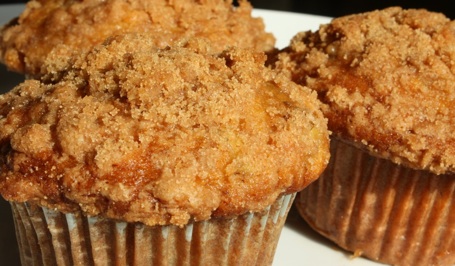
The Picky Apple won’t eat bananas by themselves, but he WILL eat banana muffins.  Although we have our tried and true Banana Crunch Muffin recipe, I wanted to find another banana bread or muffin recipe for a little banana variety.  We’ve had lots of extra ripe bananas around here lately as they are one of the few foods The Littlest Apple (aka The EXTREMELY Picky Apple) will eat.  I found this recipe on allrecipes.com, with 5 stars and 2,615 reviews.  With that many great reviews, I had high hopes for these muffins.  We weren’t disappointed.  The Picky Apple agreed that these are definitely 5 star muffins and wants to add them to our regular muffin rotation.  High praise indeed!  His only complaint was that the recipe only made 10 muffins!

Banana Crumb Muffins

from allrecipes.com

Ingredients:

  • 1 1/2 cups all-purpose flour
  • 1 teaspoon baking soda
  • 1 teaspoon baking powder
  • 1/2 teaspoon salt
  • 3 bananas, mashed
  • 3/4 cup white sugar
  • 1 egg, lightly beaten
  • 1/3 cup butter, melted
  • 1/3 cup packed brown sugar
  • 2 tablespoons all-purpose flour
  • 1/8 teaspoon ground cinnamon
  • 1 tablespoon butter

Directions:

  1. Preheat oven to 375 degrees F (190 degrees C). Lightly grease 10 muffin cups, or line with muffin papers.
  2. In a large bowl, mix together 1 1/2 cups flour, baking soda, baking powder and salt. In another bowl, beat together bananas, sugar, egg and melted butter. Stir the banana mixture into the flour mixture just until moistened. Spoon batter into prepared muffin cups.
  3. In a small bowl, mix together brown sugar, 2 tablespoons flour and cinnamon. Cut in 1 tablespoon butter until mixture resembles coarse cornmeal. Sprinkle topping over muffins.
  4. Bake in preheated oven for 18 to 20 minutes, until a toothpick inserted into center of a muffin comes out clean.
Jul 12 08
by cara
at 8:34 AM

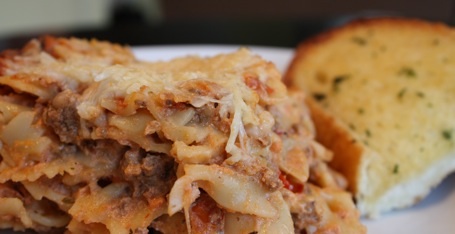
Ricotta Pasta Casserole

This recipe is based loosely on Emeril’s recipe for Penne a La Vodka Casserole.  Emeril’s recipe includes hot Italian sausage, and if you like Italian sausage, this is a great recipe (with or without the vodka).  Although we enjoyed Emeril’s original recipe, The Picky Apple and I aren’t big fans of Italian sausage.  This time around I deviated from the original recipe quite a bit, using ground beef instead of Italian sausage, omitting the vodka, using farfalle instead of penne, and changing the topping.

Ricotta Pasta Casserole

Ingredients:

  • 1 pound ground sirloin
  • 1/3 cup chopped onion
  • 1 tsp salt
  • 1/2 tsp pepper
  • 1/2 tsp basil
  • 2 tsp chopped garlic
  • 1 (24 oz) jar of marinara sauce
  • 1/2 tsp Essence
  • 1/3 cup heavy cream
  • 1 pound pasta (penne, farfalle, or similar size)
  • 15 oz ricotta
  • 1/2 cup Parmesean
  • 1/2 cup Romano

Preheat the oven to 350 degrees F.Heat 2 tablespoons extra-virgin olive oil in a large skillet or saucepan over high heat. Add the ground beef and cook, stirring, until browned, 4 to 5 minutes. Add the onions, salt, and the black pepper. Cook, stirring occasionally, until the onions are just soft, about 4 minutes. Add the basil and garlic, and cook, stirring, for 2 minutes. Add the tomatoes; reduce the heat to medium-low, and simmer, uncovered, stirring occasionally, for 10 minutes. Add the Essence and heavy cream, stir to mix, and simmer for 5 minutes. Remove from the heat.

To cook the pasta, combine 4 quarts water, the 1 tablespoon olive oil, and the remaining 1 teaspoon salt in a large pot over high heat. Bring to a boil, add the pasta, and cook until al dente, 12 to 14 minutes. Remove from the heat and drain well. Combine half of the ricotta cheese and half of the Parmesan with the remaining 2 tablespoons extra-virgin olive oil in a large mixing bowl. Add the pasta and toss to coat evenly. Add the sausage mixture and mix well. Add the remaining ricotta cheese and mix well.

Transfer the mixture to a 9 by 13-inch baking dish. Sprinkle with the remaining Parmesan and Romano. Bake until bubbly and golden, about 45 minutes. Remove from the oven.

Jul 10 08
by cara
at 9:06 AM

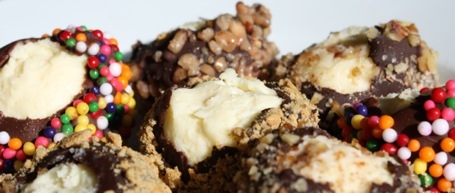
Cheesecake Pops

This is a recipe I’ve had on my “to bake” list for quite some time now.  It started when my husband gave me the Sticky Chewy Messy Gooey cookbook by JIll O’ Connor for Valentine’s Day this year.  This cookbook is full of yummy looking desserts, but this one in particular caught my eye.  This recipe turned up again in my life as the Daring Bakers challenge for the month of April, but unfortunately I was not able to participate that month.  Since then, I’ve been looking for an excuse to make the cheesecake pops, preferably an event with plenty of people to eat the 40+ super-rich cheesecake pops I knew I’d wind up with.

I finally got around to making these for my friend’s 30th birthday party: a super fun evening filled with fajitas, margaritas, and roller skating!  We had the whole rink to ourselves, and there were costumes, races, games of Red Light Green Light, and limbo.  The Picky Apple won the men’s race, and he brought home a fabulous inflatable shark as his prize.  A fun time was had by all, and though there were plenty of wipeouts, nobody got seriously injured.  I had a bad wipeout in the skating rink bathroom, of all places.  Luckily, no one was around to point and laugh (and believe me, it was laugh worthy), but I still have a huge bruise on my elbow and a sore neck.

But back to the main attraction: the dessert!  For the cheesecake pops, I opted not to use the lollipop sticks, but if I make them again, I will definitely go the extra mile and use lollipop sticks and ribbon.  I also still need to perfect my technique because they look a little blobby.  I used Baker’s Dipping Chocolate in both milk and dark chocolate.  I love this stuff!  I used it previously for some chocolate dipped strawberries.  My toppings for the cheesecake balls included pecans, graham crackers, toffee bits, jumbo rainbow nonpareils, and mini rainbow nonpareils.  My favorite combo was dark chocolate with toffee, and The Picky Apple liked the milk chocolate with graham cracker, but they all turned out great!    I’ll be using the filling recipe again the next time I make a cheesecake- the texture and flavor was perfect!

Cheesecake Pops

from Sticky, Chewy, Messy Gooey by Jill O’Connor

Makes 30-40 pops

Ingredients:

  • 5 8-oz packages cream cheese, at room temperature
  • 2 cups sugar
  • 1/4 cup all purpose flour
  • 1/4 teaspoon salt
  • 5 large eggs
  • 2 egg yolks
  • 2 teaspoons pure vanilla extract
  • 1/4 cup heavy cream
  • Boiling water as needed
  • 30-40 8 inch lollipop sticks
  • 1 pound semisweet flavored, milk chocolate flavored, or brightly colored confectionery coating

Position an oven rack in the middle of the oven and preheat to 325 degrees F.

In a large bowl, with an electric mixer set at low speed, beat together the cream cheese, sugar, flour, and salt until smooth.  Add the whole eggs and the egg youlks, one at a time, beating well (but still at low speed) after each addition.  Beat in the vanilla and cream.

Lightly grease a 10 inch cake pan (NOT a springform pan).  Pour the cheesecake batter into the cake pan and place in a larger roasting pan.  Fill the roasting pan with boiling water until it reaches halfway up the sides of the cake pan.  Bake until the cheesecake is firm and slightly golden on top, 35 to 45 minutes.

Remove the cheesecake from the water bath and cool to room temperature.  Cover the cheesecake with plastic wrap and refrigerate until very cold, at least 3 hours or up to overnight.

When cold and very firm, scoop the cheesecake into 2-ounce balls and place on a parchment paper-lined baking sheet.  Carefully insert a lollipop stick into each cheesecake ball.  Freeze the pops, uncovered, until very hard, at least 1 to 2 hours.

When the cheesecake pops are frozen and ready for dipping, prepare the chocolate coating.  Place half of the chocolate wafers in a microwave-safe bowls.  Microwave on high for 30 seconds.  Remove from the microwave and stir.  If the chocolate is not completely melted, microwave for 30-seconds intervals, stirring until smooth.

Quickly dip a frozen cheesecake pop in the melted chocolate, swirling quickly to coat it completely.  Hold the pop over the melted chocolate and shake off any excess.  Place the pop on a clean parchment paper-lined baking sheet to set.  Repeat with remaining pops, melting more chocolate wafers as needed.

Refrigerate the pops for up to 24 hours, until ready to serve.

Jul 3 08
by cara
at 2:28 PM

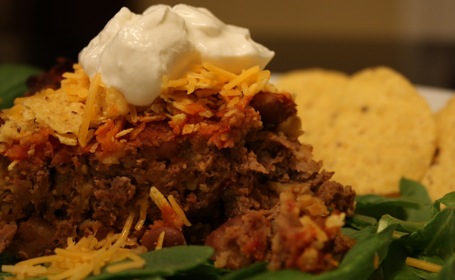
Tex Mex Meatloaf

I hate meatloaf.  There, I said it.  Believe me, I want to like it.  Meatloaf is one of those classic American comfort foods, and from what I’ve heard, it goes great with mashed potatoes (which I love).  I have tried a handful of different meatloaf recipes, but to no avail.  I just haven’t found one that I like.  Until now.  Now granted, this isn’t your standard all-American meatloaf, and perhaps that’s why I like it.  That’s certainly why I decided to give it a chance in the first place.  Anything with “Tex-Mex” in the title gives me pause, and this recipe made it all the way to my recipe file, despite also having “Meatloaf” in the title.  This meatloaf, if you can even call it that, tastes very taco and/or chili-like.  It definitely isn’t the prettiest dish on the block.  But give this ugly meatloaf a try, won’t you?

Tex-Mex Meatloaf

from Southern Living, May 2008

Ingredients:

  • 2 lb. ground round
  • 1 1/2 cups crushed tortilla chips, divided
  • 1 (16 oz) can chili beans in sauce, undrained
  • 1 (10 oz) can diced tomatoes with green chiles, drained
  • 1 1/4 tsp. chili powder
  • 1 tsp. ground cumin
  • 2 large eggs, lightly beaten
  • 1/2 cup chopped onion
  • 1 garlic clove, minced
  • 1 tsp.  salt
  • 1/4 tsp. pepper
  • 1/2 cup salsa
  • Torn lettuce leaves
  • Tortilla chips
  • Toppings: sour cream, grated Cheddar cheese, chopped tomatoes, sliced olives, guacamole

1.  Preheat oven to 350 degrees F.  Stir together ground round, 1 cup crushed tortilla chips, beans, and next 8 ingredients in a large bowl until just combined.

2.  Transfer mixture to a lightly greased 9 inch deep-dish pieplate.  Place on a rimmed baking sheet.  Bake at 350 degrees F for 45 minutes.  Spoon 1/2 cup salsa evenly over meatloaf; sprinkle with remaining 1/2 cup tortilla chips.  Bake 20 to 25 more minutes or until center is no longer pink.  Let stand 10 minutes.  Cut into wedges.  Serve over lettuce with tortilla chips and desired toppings.

Jun 26 08
by cara
at 3:59 PM

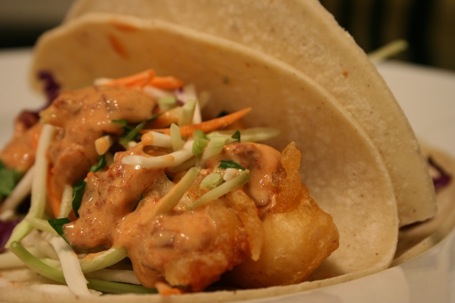
Baja Fish Tacos

I had my first-ever fish tacos a few weeks ago, and absolutely LOVED them.  Why didn’t anybody clue me in on these any sooner?!  I ordered them again at a different restaurant a week later and loved them even more.  Coincidentally, shortly after both of those delicious dining experiences, the cooking section of The Houston Chronicle featured a story on fish tacos and included several recipes.  Of course I snagged those pages and added them to the top of my recipe file (or should I say pile?).  One recipe in particular grabbed my attention since it features a spicy beer batter and two different yummy sauces.  I gave that recipe a go earlier this week.  I was extremely pleased with the results even though I played around a little with the sauces to suit my preferences and ingredients I had on hand.  These were delicious and The PIcky Apple enjoyed them too.

Baja Fish Tacos

From The Houston Chronicle

Spice Chile Sauce (optional)

  • 1/2 a 7 ounce can chipotle chiles in adobo sauce
  • 1/4 cup mayonnaise (I used more yogurt instead)
  • 1/4 cup yogurt
  • 3/4 cup light sour cream
  • 1/2 tablespoon Valentina Hot Sauce (I omitted, only because we were all out of sauce)
  • 1/4 teaspoon sugar

Avocado Sauce (optional):

  • 1 ripe avocado, peeled
  • 2 tablespoons light sour cream
  • 2 tablespoons milk, plus more to thin sauce if necessary
  • Juice of half a lime
  • 4 cilantro sprigs, stemmed and chopped
  • Salt

Tacos:

  • 1 cup tempura flour (I used a box of McCormick’s Tempura batter, found near the other fish fry products)
  • 1/2 teaspoon onion powder
  • 1/4 teaspoon cayenne
  • 1/2 teaspoon Coleman’s dry mustard
  • 1/2 teaspoon oregano, rubbed to a powder
  • 1 1/2 teaspoon kosher salt, plus more to season fish
  • 1 cup cold beer, plus more to thin the batter if necessary (Corona was what we had on hand)
  • 1 pound firm, meaty fish (halibut, mahi-mahi or tilapia) or 1 pound of small to medium shrimp, peeled and deveined (I went with tilapia because it was cheapest)
  • Juice of one lime
  • Salt
  • Canola oil for frying
  • 12 corn tortillas
  • Finely shredded green or purple cabbage  (I used a bag mix that included green and purple cabbage, as well as broccoli, cauliflower, and carrots)
  • Chopped cilantro
  • 3 or 4 limes cut into wedges

To make the Spicy Chile Sauce, blend chipotle chiles, mayonnaise, yogurt, sour cream, hot sauce and sugar in a food processor until creamy.  Pour into a container and refrigerate until ready to use.

To make the Avocado Sauce, pulse the avocado, sour cream, milk and lime juice in a food processor until it is creamy.  Ad more milk if necessary , until sauce is the consistency of whipping cream.  Add the cilantro and salt to taste; pulse until just blended.  Pour into a container and refrigerate until ready to use.

The batter can be made several hours ahead and refrigerated until you are ready to use it.  To make the batter, combine the flour, onion powder, cayenne mustard, oregano and salt in a bowl.  Whisk in the beer.  It is okay if there are some small lumps.

Cut the fish into 1/4 inch thick slices about the size and shape of a very large index finger.  Sprinkle with lime juice and salt.

Pour oil to the depth of 1 1/2 inches in a deep, wide cast-iron skillet.  Heat over medium heat to 350 degrees.

Pat the fish dry with paper towels.  Dip a few pieces of fish into the batter, which should be the consistency of pancake batter (add more beer if it is too thick).  Using tongs, swish the pieces until coated.  Remove the fish, letting excess batter drip back into the bowl; place the fish in the hot oil.  Cook a few pieces at a time to avoid crowding the pan and lowering the temperature of the oil, until they float and the batter is golden-brown.  Place the fish on paper towels to drain.

Heat tortillas on a dry griddle for about 1 minute on each side, or microwave them briefly until pliable.  To serve, let each person assemble his or her own tacos to suit, with sauces, shredded cabbage, cilantro and lime wedges.

May 29 08
by cara
at 9:16 PM

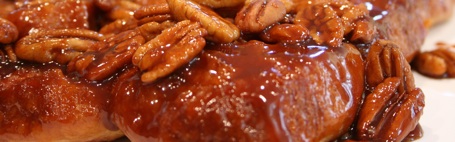
Pecan Honey Sticky Buns, Part 2

I finally made it to the store and attempted to make the Pecan Honey Sticky Buns again.  This time, the dough came together nicely.  The smell of these sticky buns baking was absolutely AMAZING!  No candle, potpourri or other fragrance can replicate that scent, though I do love to burn bakery scents when I’m not baking.

Pecan Honey Sticky Buns
Makes 15 buns

For the Glaze:

1 cup (packed) light brown sugar
1 stick (8 tablespoons) unsalted butter, cut into 4 pieces
1/4 cup honey
1-1/2 cups pecans (whole or pieces)

For the Filling:

1/4 cup sugar
3 tablespoons (packed) light brown sugar
1 tablespoon ground cinnamon
3 tablespoons unsalted butter, at room temperature

For the Buns:

1/2 recipe dough for Golden Brioche loaves (see below), chilled and ready to shape (make the full recipe and cut the dough in half after refrigerating it overnight)

Generously butter a 9-x-13-inch baking pan (a Pyrex pan is perfect for this).

To make the glaze: In a heavy-bottomed saucepan, bring the brown sugar, butter, and honey to a boil over medium-low heat, stirring frequently to dissovle the sugar.  Pour the glaze into the buttered pan, evening it out asbest you can by tilting the pan or spreading the glaze with a heatproof spatula.  Sprinle over the pecans.

To make the filling: Mix the sugars and cinnamon together in a bowl. If necessary, in another bowl, work the butter with a spatula until it is soft, smooth and spreadable.

To shape the buns: On a flour-dusted work surface, roll the chilled dough into a 16-inch square. Using your fingers or a pastry brush, spread the softened butter over the dough. Sprinkle the dough with the cinnamon sugar, leaving a 1-inch strip bare on the side farthest from you. Starting with the side nearest you, roll the dough into a cylinder, keeping the roll as tight as you can. (At this point, you can wrap the dough airtight and freeze it for up to 2 months . . . . Or, if you want to make just part of the recipe now, you can use as much of the dough as you’d like and freeze the remainder. Reduce the glae recipe accordingly).

With a chef’s knife, using a gentle sawing motion, trim just a tiny bit from the ends of the roll if they’re very ragged or not well filled, then cut the log into 1-inch thick buns. (Because you trim the ragged ends of the dough, and you may have lost a little length in the rolling, you will get 15 buns, not 16.) Fit the buns into the pan cut side down, leaving some space between them.

Lightly cover the pan with a piece of wax paper and set the pan in a warm place until the buns ahve doubled in volume, about 1 hour and 45 minutes. The buns are properly risen when they are puffy, soft, doubled and, in all likelihood, touching one another.

Getting ready to bake: When the buns have almost fully risen , center a rack in the oven and preheat the oven to 375 degrees  F.
Remove the sheet of wax paper and put the pan on a baking sheet lined with parchment or a silicone mat.  Bake the sticky buns for about 30 minutes, or until they are puffed and gorgeously golden; the glaze will be bubbling away merrily.  Pull the pan from the oven.
The sticky buns must be unmolded minutes after they come out of the oven.  If you do not have a rimmed platter large enough to hold them, use a baking sheet lined with a silicone mate or buttered foil.  Be careful – the glaze is super-hot and super-sticky.

What You’ll Need for the Golden Brioche Dough (this recipe makes enough for two brioche loaves. If you divide the dough in half, you would use half for the sticky buns, and you can freeze the other half for a later date, or make a brioche loaf out of it!):

2 packets active dry yeast (each packet of yeast contains approx. 2 1/4 teaspoons)
1/3 cup just-warm-to-the-touch water
1/3 cup just-warm-to-the-touch whole milk
3 1/3 cups all-purpose flour
2 teaspoons salt
3 large eggs, at room temperature
1/4 cup sugar
3 sticks (12 ounces) unsalted butter, at room temperature but still slightly firm

What You’ll Need for the Glaze (you would brush this on brioche loaves, but not on the sticky buns):

1 large egg
1 tablespoon water

To Make The Brioche: Put the yeast, water and milk in the bowl of a stand mixer and, using a wooden spoon, stir until the yeast is dissolved. Add the flour and salt, and fit into the mixer with the dough hook, if you have one. Toss a kitchen towel over the mixer, covering the bowl as completely as you can– this will help keep you, the counter and your kitchen floor from being showered in flour. Turn the mixer on and off a few short pulses, just to dampen the flour (yes, you can peek to see how you’re doing), then remove the towel, increase the mixer speed to medium-low and mix for a minute or two, just until the flour is moistened. At this point, you’ll have a fairly dry, shaggy mess.

Scrape the sides and bottom of the bowl with a rubber spatula, set the mixer to low and add the eggs, followed by the sugar. Increase the mixer speed to medium and beat for about 3 minutes, until the dough forms a ball. Reduce the speed to low and add the butter in 2-tablespoon-size chunks, beating until each piece is almost incorporated before adding the next. You’ll have a dough that is very soft, almost like batter. Increase the speed to medium-high and continue to beat until the dough pulls away from the sides of the bowl, about 10 minutes.

Transfer the dough to a clean bowl (or wash out the mixer bowl and use it), cover with plastic wrap and leave at room temperature until nearly doubled in size, 40 to 60 minutes, depending upon the warmth of your room.

Deflate the dough by lifting it up around the edges and letting it fall with a slap to the bowl. Cover the bowl with the plastic wrap and put it in the refrigerator. Slap the dough down in the bowl every 30 minutes until it stops rising, about 2 hours, then leave the uncovered dough in the refrigerator to chill overnight. (After this, you can proceed with the recipe to make the brioche loaves, or make the sticky buns instead, or freeze all or part of the dough for later use.)

The next day, butter and flour two 8 1/2-x-4 1/2-inch pans.

Pull the dough from the fridge and divide it into 2 equal pieces. Cut each piece of the dough into 4 equal pieces and roll each piece into a log about 3 1/2 inches long. Arrange 4 logs crosswise in the bottom of each pan. Put the pans on a baking sheet lined with parchment or a silicone mat, cover the pans lightly with wax paper and leave the loaves at room temperature until the dough almost fills the pans, 1 to 2 hours. (Again, rising time with depend on how warm the room is.)

Getting Ready To Bake: Center a rack in the oven and preheat the oven to 400 degrees F.

To Make the Glaze: Beat the egg with the water. Using a pastry brush, gently brush the tops of the loaves with the glaze.

Bake the loaves until they are well risen and deeply golden, 30 to 35 minutes. Transfer the pans to racks to cool for 15 minutes, then run a knife around the sides of the pans and turn the loaves out onto the racks. Invert again and cool for at least 1 hour.

May 27 08
by cara
at 7:30 AM

Pecan Honey Sticky Buns, Part 1

This week’s Tuesdays With Dorie recipe for Pecan Honey Sticky Buns was selected by Madam Chow of Madam Chow’s Kitchen.  The sticky buns are made from a brioche dough.  This was my first attempt at making both brioche and sticky buns, though I’ve made many a cinnamon roll before.  I knew from reading other bloggers experiences that I could expect the dough to be sticky, so as my dough was coming together, I though nothing of how batter-like it appeared.  But when the dough failed to form a ball and pull away from my stand mixer after a good 15-20 minutes on medium-high in the mixer, I knew something was wrong.  My first thought was that maybe I just wasn’t being patient enough.  Sometimes I can be a little on the impatient-side.  (I’m sure The Picky Apple and my parents are getting a good chuckle out of that statement!)  Then I remembered that I was trying to half the recipe…and forgot to half the eggs!  Dough FAIL!  I hate it when that happens.  And of course, I used the last of the butter, yeast, and eggs I had on hand, and it was time to put the baby to bed and then dinner.  I’ll be going to the store this morning after The Littlest Apple wakes up from his nap (assuming he takes one) to purchase new ingredients so I can try this again.  I’m not going to be defeated by the brioche!  Hopefully I’ll be back tomorrow with a photo of some gorgeous looking Pecan Honey Sticky Buns, but for now, check out how everyone else fared at Tuesdays With Dorie!

May 26 08
by cara
at 8:52 PM

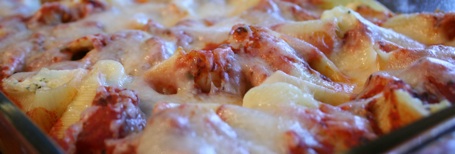
Chicken and Spinach Stuffed Shells

Over the last few years, I have experimented with many different variations of stuffed shells.  Stuffed shells is one of my favorite dishes to serve to company, along with caesar salad, garlic bread, wine, and something chocolatey for dessert.  My previous attempts at stuffed shells included some combination of ground beef, chicken (chopped, chunks, seasoned), ricotta, parmesean, cream cheese, garlic and herb cheese spread, red sauce, white sauce, black olives, and mushrooms.  None of my previous attempts have included spinach, even though The Picky Apple and I both enjoy pasta stuffed with chicken and spinach when dining out.  When I saw this recipe for Chicken and Spinach Stuffed Shells on The Sisters’ Cafe, I had a “duh” moment….why didn’t I think to try that before?!  I was very pleased with how these turned out, though I did have quite a bit of extra filling leftover.  You can find the recipe over at The Sisters’ Cafe.  This is one of my favorite food blogs…I feel like I bookmark almost every recipe this group of sisters posts!

May 20 08
by cara
at 10:42 AM

Brown Sugar-Pecan Shortbread Cookies

Shortbread is quickly becoming one of my favorite things to bake.  It has become one of my go-to egg-free desserts.  I used to think that shortbread was boring and plain and tended to skip right past most shortbread recipes.  But now recipes for shortbread catch my eye.  Now I can’t resist the deliciously buttery and slightly sweet goodness that is shortbread!  This week’s Tuesdays With Dorie recipe was Traditional Madelines, chosen by Tara of Smells Like Home, but since madelines require a special pan that I don’t have, I revisited one of the previously baked Tuesdays With Dorie recipes that I’ve been itching to try.  These Brown Sugar-Pecan Shortbread Cookies were the very first recipe selected for Tuesdays With Dorie.  The title alone caught my eye and drew me in, but the recipe itself is super simple and requires minimal ingredients.  I overcooked my shortbread cookies, but they still taste great.  They smelled so enticing while baking and cooling…it was hard waiting for them to cool completely (as Dorie suggests) before eating one.  The sweetness of the brown sugar, the nuttiness of the ground pecans, and the hint of cloves make these cookies a little more sophisticated than your basic shortbread, and as Dorie mentions, perfect with coffee or tea.

No pictures this week, unfortunately…camera is still out of commission.

Brown Sugar-Pecan Shortbread Cookies

Ingredients:

  • 1 1/2 cups all-purpose flour
  • 1/4 cup cornstarch
  • 1/4 teaspoon salt
  • Pinch of ground cloves
  • 2 sticks (8 ounces) unsalted butter, at room temperature
  • 3/4 cup (packed) light brown sugar
  • 1/2 cup finely ground pecans
  • Confectioners’ sugar, for dusting (optional)

Sift together the flour cornstarch, salt and cloves.  Working with a stand mixer, preferably fitted with a paddle attachment, or with a hand mixer in a large bowl, beat the butter and brown sugar together on medium speed for about 3 minutes, until the mixture is very smooth.  Reduce the mixer speed to low and add the dry ingredients, mixing only until they disappear into the dough.  Don’t work the dough much once the flour is incorporated.  Add the pecans and give the mixer a couple of turns, just to get the nuts into the dough.

Using a rubber spatula, transfer the soft, sticky dough to a gallon-size zipper-lock plastic bag.  Put the bag on a flat surface, leaving the top open, and roll the dough into a 9-x-10 1/2 inch rectangle that is 1/4 inch thick.  As you roll, turn the bag occasionally and lift the plastic from the dough so it doesn’t cause creases.  When you get the right size and thickness, seal the bag, pressing out as much air as possible, and refrigerate the dough for at least 2 hours, or for up to 2 days.

Getting Ready To Bake: Position the racks to divide the oven into thirds and preheat the oven to 350 degrees F.  Line two baking sheets with parchment or silicone mats.

Put the plastic bag on a cutting board and slit it open.  Turn the firm dough out onto the cutting board (discard the bag) and, using a ruler as a guide and a sharp knife, cut the dough into 1 1/2-inch squares.  Transfer the squares to the baking sheets and carefully prick each one twice with a fork, gently pushing the tines through the cookies until they hit the sheet.

Bake for 18 to 20 minutes, rotating the sheets from top to bottom and front to back at the midway point.  The shortbreads will be very pale-they shouldn’t take on much color.  Transfer the cookies to a rack.

If you like, dust the cookies with confectioners’ sugar while they are hot.  Cool the cookies to room temperature before serving.

Blog Widget by LinkWithin